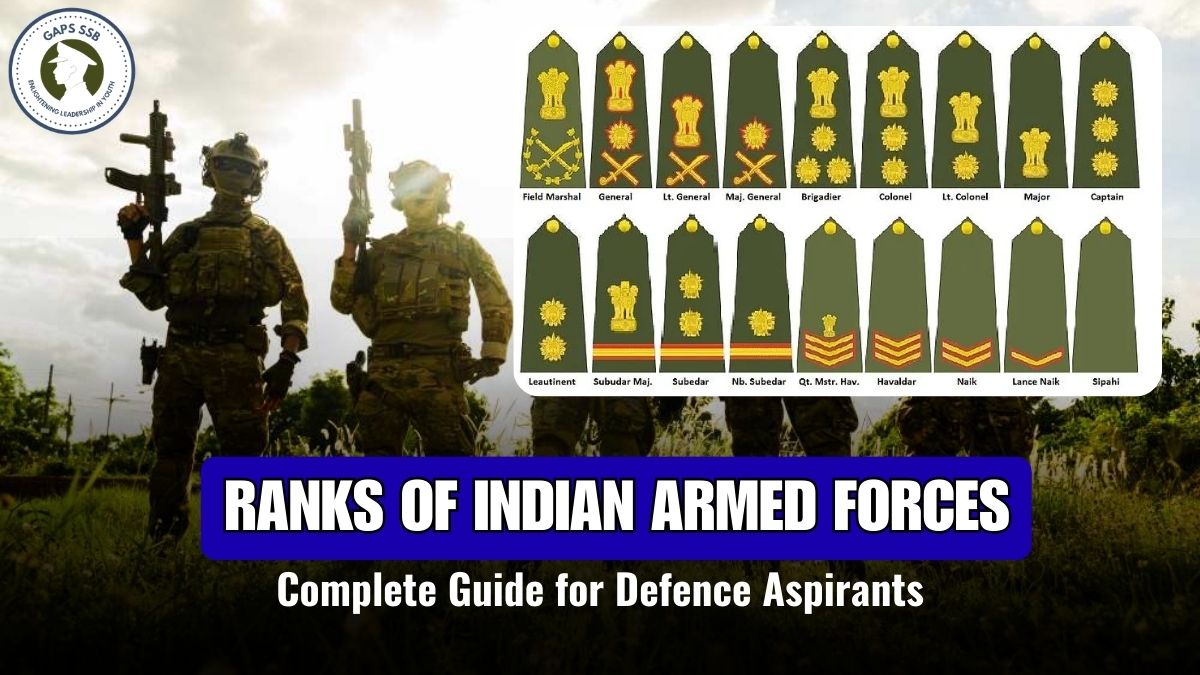
Understanding the Equivalent ranks of Indian Armed Forces is essential for defence aspirants preparing for competitive exams and personality assessments. The Indian Armed Forces consist of three services — the Indian Army, Indian Navy, and Indian Air Force — and each service follows a structured hierarchy of ranks.
Although the titles differ across the services, their authority levels are considered equivalent. Learning the Equivalent ranks of Indian Armed Forces helps aspirants understand how officers from different services correspond to each other in terms of command and responsibility.
For candidates preparing for defence interviews and personality assessments, knowledge about the Equivalent ranks of Indian Armed Forces also reflects awareness about military organization and leadership structure.
What Are the Equivalent Ranks of Indian Armed Forces?
The Equivalent ranks of Indian Armed Forces refer to the matching officer ranks between the Army, Navy, and Air Force. Even though each service uses different terminology, the command level and responsibilities are aligned.
For example:
- A Captain in the Army is equivalent to a Lieutenant in the Navy and a Flight Lieutenant in the Air Force.
- A Colonel in the Army corresponds to a Captain in the Navy and a Group Captain in the Air Force.
Understanding these Equivalent ranks of Indian Armed Forces is important because officers from all three services often work together in joint military operations.
Commissioned Officer Ranks – Indian Armed Forces
Below is a simplified comparison of the Equivalent ranks of Indian Armed Forces across the three services.
5-Star Rank (Ceremonial)
- Indian Army – Field Marshal
- Indian Navy – Admiral of the Fleet
- Indian Air Force – Marshal of the Air Force
4-Star Rank
- Indian Army – General
- Indian Navy – Admiral
- Indian Air Force – Air Chief Marshal
3-Star Rank
- Indian Army – Lieutenant General
- Indian Navy – Vice Admiral
- Indian Air Force – Air Marshal
2-Star Rank
- Indian Army – Major General
- Indian Navy – Rear Admiral
- Indian Air Force – Air Vice Marshal
1-Star Rank
- Indian Army – Brigadier
- Indian Navy – Commodore
- Indian Air Force – Air Commodore
Senior Officer Rank
- Indian Army – Colonel
- Indian Navy – Captain
- Indian Air Force – Group Captain
Mid-Level Officer Rank
- Indian Army – Lieutenant Colonel
- Indian Navy – Commander
- Indian Air Force – Wing Commander
Junior Officer Rank
- Indian Army – Major
- Indian Navy – Lieutenant Commander
- Indian Air Force – Squadron Leader
Entry Level Officer Rank
- Indian Army – Captain
- Indian Navy – Lieutenant
- Indian Air Force – Flight Lieutenant
Initial Commission Rank
- Indian Army – Lieutenant
- Indian Navy – Sub Lieutenant
- Indian Air Force – Flying Officer
This structure clearly shows the Equivalent ranks of Indian Armed Forces across the three services.
Ranks of Indian Army
The ranks of Indian Army follow a clear hierarchy from junior officers to the highest military leadership.
Here is the army rank list for commissioned officers:
- Lieutenant
- Captain
- Major
- Lieutenant Colonel
- Colonel
- Brigadier
- Major General
- Lieutenant General
- General
- Field Marshal (Ceremonial Rank)
This army rank list represents the complete officer hierarchy within the Indian Army.
Army Rank List in Order
For aspirants preparing for defence exams, it is important to remember the army rank list in order.
The army rank list in order starts from the junior-most officer rank and progresses to the highest leadership position.
Army Rank List in Order:
Lieutenant → Captain → Major → Lieutenant Colonel → Colonel → Brigadier → Major General → Lieutenant General → General → Field Marshal
Learning the army rank list in order helps candidates understand the chain of command within the Army.
Highest Rank in Indian Army
One of the most frequently asked questions is about the highest rank in Indian army.
The highest rank in Indian army during active service is General, which is held by the Chief of Army Staff.
However, the ceremonial highest rank in indian army is Field Marshal, which is awarded only in exceptional circumstances. This rank is rarely conferred and represents the highest military honor.
Understanding the highest rank in indian army is important when studying the Equivalent ranks of Indian Armed Forces.
Salary Structure in Indian Armed Forces
After the implementation of the 7th Central Pay Commission, the salary structure for officers in the Indian Armed Forces was revised.
The pay levels correspond to the rank hierarchy within the Equivalent ranks of Indian Armed Forces system.
Indian Army Salary Overview
- Lieutenant – Approximately ₹70,000 per month
- Captain – Approximately ₹77,000 per month
- Major – Around ₹88,000 per month
- Lieutenant Colonel – Around ₹1.24 lakh per month
- Colonel – Around ₹1.35 lakh per month
- Brigadier – Around ₹1.44 lakh per month
- Major General – Around ₹1.50 lakh per month
- Lieutenant General – Around ₹1.90 lakh per month
- General – Around ₹2.25 lakh per month
In addition to basic salary, officers receive allowances such as:
- Military Service Pay
- Field Area Allowance
- High Altitude Allowance
- Travel and medical benefits
These benefits apply across the Equivalent ranks of Indian Armed Forces depending on the service branch.
Importance of Knowing Equivalent Ranks
Understanding the Equivalent ranks of Indian Armed Forces is important for several reasons.
1. Joint Military Operations
The Army, Navy, and Air Force frequently work together during military operations. Knowledge of the Equivalent ranks of Indian Armed Forces ensures smooth coordination.
2. Defence Examination Preparation
Many defence examinations include questions related to the army rank list, army rank list in order, and the highest rank in indian army.
3. Personality Assessments
Candidates appearing for officer selection interviews are often expected to understand the structure of the military hierarchy.
Therefore, learning the Equivalent ranks of Indian Armed Forces is a crucial part of defence awareness.
Conclusion
The Equivalent ranks of Indian Armed Forces help establish a unified hierarchy between the Indian Army, Navy, and Air Force. Even though the titles differ, their responsibilities and command levels are aligned across the services.
From the entry-level ranks such as Lieutenant, Sub Lieutenant, and Flying Officer to the senior-most ranks like General, Admiral, and Air Chief Marshal, the system ensures a clear chain of command.
For defence aspirants studying the ranks of indian army, the army rank list, and the army rank list in order, understanding the Equivalent ranks of Indian Armed Forces is essential. It provides a deeper insight into how the three services operate together to protect the nation.