Role of Group Discussion in the SSB Interview
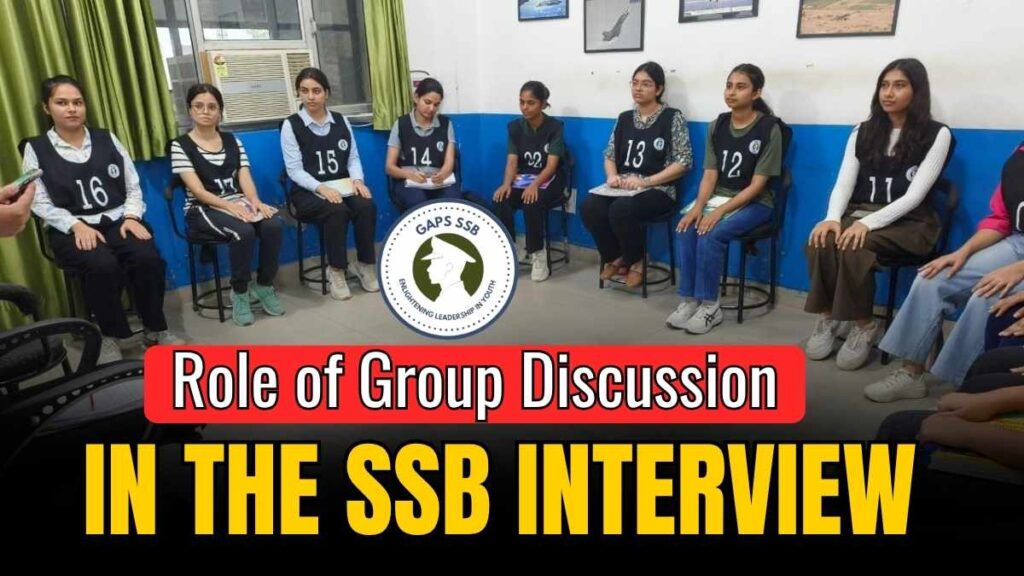
The Group Discussion in the SSB Interview is one of the most important tasks conducted during the Group Testing Officer (GTO) series. It is designed to assess a candidate’s communication skills, leadership qualities, teamwork, and ability to think logically under pressure. Unlike other tests, GD is not about speaking the most but about contributing effectively while maintaining group harmony. At GAPS SSB, candidates are trained to master the Group Discussion in the SSB Interview with confidence, clarity, and officer-like behavior. Understanding Group Discussion in the SSB Interview What Happens in GD? The Group Discussion in the SSB Interview is usually conducted on Day 2 or Day 3 of the SSB process. Types of Topics Current Affairs Topics Abstract Topics Candidates must present their views clearly and support them with logical arguments. Why Group Discussion is Important in SSB The Group Discussion in the SSB Interview plays a crucial role in evaluating overall personality. Communication Skills Clear and confident communication is essential for an officer. GD helps assess how effectively you express your ideas. Leadership Qualities Leadership is not about dominating but guiding the group positively. Initiating discussion or summarizing shows leadership. Logical Thinking Your arguments should be structured and meaningful. Logical reasoning reflects maturity and decision-making ability. Teamwork and Cooperation The armed forces work on teamwork. GD checks whether you respect others and work as part of a team. Emotional Intelligence Handling disagreements calmly and respectfully is a key trait assessed in GD. Common Mistakes to Avoid in GD Dominating the Discussion Speaking too much or interrupting others shows poor team spirit. Remaining Silent Not speaking at all gives a negative impression of lack of confidence. Lack of Knowledge Without basic awareness, it becomes difficult to contribute meaningfully. Poor Body Language These reduce your overall impact. Going Off Topic Irrelevant points waste time and show lack of focus. Tips to Excel in Group Discussion in the SSB Interview Stay Updated Regularly follow current affairs and important national and global issues. Practice Regularly Structure Your Points Use simple and clear structure: Be a Good Listener Listening is as important as speaking. Maintain Positive Body Language Respect Different Opinions Disagreements should be polite and logical. Example:“I understand your point, but I would like to add another perspective.” Try to Initiate or Conclude Step-by-Step Strategy for GD Success Step 1: Understand the Topic Take a few seconds to think before speaking. Step 2: Start Strong If confident, begin the discussion with a clear introduction. Step 3: Contribute Meaningfully Speak 2–3 times with quality points instead of speaking too much. Step 4: Support the Group Encourage quieter members and maintain group balance. Step 5: Conclude Effectively Summarize key points discussed and give a balanced ending. How GAPS SSB Helps in GD Preparation At GAPS SSB, candidates receive complete guidance for the Group Discussion in the SSB Interview. Training Includes Focus Areas This structured training helps candidates perform confidently in GD and other SSB tasks. Importance of Consistency in GD Preparation Regular practice improves: Consistency is the key to mastering the Group Discussion in the SSB Interview. Final Thoughts The Group Discussion in the SSB Interview is not just about speaking well; it is about demonstrating leadership, teamwork, and clarity of thought. A balanced approach, where you speak confidently while respecting others, is the key to success. With proper preparation, regular practice, and expert guidance from GAPS SSB, you can excel in GD and move closer to your goal of becoming an officer in the Armed Forces. Stay confident, stay informed, and always present your best self.
WAT in SSB Interview – Complete Guide for Aspirants
The WAT in SSB Interview is one of the most crucial psychological assessments conducted during the SSB selection process. It plays a significant role in evaluating a candidate’s personality, thinking pattern, and Officer Like Qualities (OLQs). Unlike written exams, this test focuses on your natural responses and how you perceive different situations. In the WAT in SSB Interview, candidates are required to think quickly and express their thoughts in a positive and meaningful way. This test is not about creativity or language skills alone, but about your mindset, attitude, and ability to handle pressure. At GAPS SSB, aspirants are trained to approach this test strategically and confidently. What is the Word Association Test? The Word Association Test is a psychological test where candidates are shown a series of words one after another. Test Format Each word appears for a limited time, and the candidate must write the first meaningful thought that comes to mind. The purpose of the WAT in SSB Interview is to capture your natural thinking process without giving you time to manipulate your answers. Importance of WAT in SSB Interview The WAT in SSB Interview is extremely important because it reflects your subconscious mind. Why It Matters Assessors carefully analyze each sentence you write in the Word Association Test to understand your behavior, attitude, and decision-making ability. Psychological Basis of Word Association Test The Word Association Test is based on the concept that your immediate response to a word reflects your inner thoughts and personality traits. What Psychologists Observe This is why honesty and natural thinking are very important in the WAT in SSB Interview. How to Approach WAT Effectively Stay Natural and Honest Do not try to create artificial or memorized responses. Your originality matters more than perfection. Think Positive Always convert any word into a positive or constructive idea. Be Quick and Clear Time is limited, so avoid overthinking. Write simple and direct sentences. Key Tips to Crack Word Association Test Focus on Officer Like Qualities (OLQs) Your responses should reflect qualities like: Use Simple Language Avoid complicated vocabulary. Simple and clear sentences are more effective. Avoid Negative Thinking Even if the word is negative, your response should be positive. Example Maintain Sentence Quality Write complete sentences with proper meaning. This is essential while practicing WAT Example for SSB Interview questions. WAT Example for SSB Interview Practicing examples helps improve speed and clarity. Sample Responses These are effective WAT Example for SSB Interview responses that reflect positivity and maturity. Advanced Strategy for WAT Practice Practice with Timer Simulate real test conditions by giving yourself 15 seconds per word. Improve Writing Speed Fast writing ensures you complete all 60 words. Build Positive Thought Patterns Train your mind to automatically think positively in every situation. Common Mistakes to Avoid in WAT Writing Negative Sentences Avoid fear, failure, or negativity in your responses. Incomplete Thoughts Do not leave sentences unfinished or unclear. Repetition of Ideas Avoid writing similar types of sentences repeatedly. Memorization Memorized answers reduce originality and are easily detected in the WAT in SSB Interview. 100 Important WAT Words for Practice Leadership and Character Leader, Integrity, Honesty, Courage, Discipline, Responsibility, Confidence, Loyalty, Dedication, Determination Defence and Patriotism Army, Navy, Airforce, Duty, Mission, Training, Sacrifice, Valor, Border, Security Intelligence and Strategy Plan, Strategy, Intelligence, Focus, Awareness, Logic, Decision, Knowledge, Innovation, Analysis Social and Emotional Traits Friendship, Respect, Unity, Empathy, Trust, Kindness, Support, Humanity, Cooperation, Gratitude Challenges and Situations Failure, Fear, Crisis, Pressure, Problem, Risk, Danger, Struggle, Obstacle, Survival Daily Practice Plan for WAT Beginner Level Intermediate Level Advanced Level This structured approach helps in mastering the Word Association Test effectively. How GAPS SSB Helps in WAT Preparation Expert Training At GAPS SSB, candidates receive complete preparation for psychological tests including the Word Association Test. What You Learn This ensures strong performance in the WAT in SSB Interview. Final Thoughts The Word Association Test is not about writing perfect English but about expressing your true personality in a positive and logical way. It is one of the most powerful tools used in the SSB selection process to judge a candidate’s mindset. By practicing regularly and learning from each WAT Example for SSB Interview, you can significantly improve your performance. Consistency, positivity, and confidence are the keys to success. With the right guidance from GAPS SSB, you can master the WAT in SSB Interview and move one step closer to achieving your dream of becoming an officer in the Armed Forces.
Situation Reaction Test (SRT): Complete Guide
The Situation Reaction Test is one of the most important parts of the SSB interview process. It plays a crucial role in assessing a candidate’s natural thinking ability, decision-making skills, and overall personality under pressure. For every defence aspirant, mastering SRT Practice for SSB is essential to improve performance and increase chances of recommendation. At GAPS SSB, candidates are trained to approach the Situation Reaction Test with clarity, confidence, and a practical mindset—helping them respond effectively in real-time situations. What is the Situation Reaction Test? The Situation Reaction Test is a psychological assessment conducted during the SSB interview. In this test: The purpose of the test is to evaluate how a candidate reacts in everyday life challenges. These responses reflect qualities like leadership, responsibility, courage, and presence of mind. Why is SRT Important in SSB? The Situation Reaction Test helps assess: Unlike theoretical exams, SSB SRT Practice focuses on your natural reactions rather than memorized answers. Key Features of Situation Reaction Test At GAPS SSB, aspirants are taught how to maintain consistency and clarity while practicing SRT Practice for SSB. How to Attempt SRT Effectively To perform well in the Situation Reaction Test, follow these strategies: 1. Be Natural and Honest Avoid artificial or unrealistic answers. Your response should reflect your true personality. 2. Stay Positive Always show a solution-oriented mindset, even in difficult situations. 3. Be Quick and Clear Time management is crucial. Do not overthink—write your first logical reaction. 4. Show Responsibility Take initiative and demonstrate leadership wherever possible. 5. Avoid Incomplete Responses Do not leave situations unanswered. Attempt all 60 questions. Sample SRT Practice for SSB with Answers Here are some examples to help you understand how to respond during SSB SRT Practice: Situation 1 He met with a serious accident while riding a bicycle, and the pillion rider was injured.Response: Took the injured person to the nearest hospital and informed family members. Situation 2 He saw fire in a village and people were panicking.Response: Calmed people, organized help to control the fire, and informed fire services. Situation 3 He was going for an interview and got dirty due to a passing vehicle.Response: Cleaned himself as much as possible and reached the interview on time. Situation 4 He saw miscreants trying to loot passengers in a train.Response: Alerted others, informed authorities, and helped in controlling the situation. Situation 5 His close friend misunderstood and hit him.Response: Stayed calm, resolved misunderstanding, and maintained friendship. Situation 6 He found a person teasing a girl in a lonely place.Response: Intervened immediately, stopped the person, and ensured the girl’s safety. Situation 7 He was preparing for exams but his father was ill.Response: Managed time efficiently, took care of his father, and continued studies. Situation 8 He boarded the wrong train.Response: Got down at the next station and boarded the correct train after checking details. These examples show how SRT Practice for SSB should focus on practical, responsible, and positive actions. Common Mistakes to Avoid in SSB SRT Practice While preparing for the Situation Reaction Test, avoid these mistakes: At GAPS SSB, candidates are trained to avoid these errors through structured SSB SRT Practice sessions. Tips to Improve SRT Performance Practice Daily Solve at least 20–30 situations regularly to build speed. Improve Thinking Ability Focus on real-life problem-solving and decision-making. Stay Calm Under Pressure Practice writing within time limits. Develop OLQs Work on leadership, responsibility, and initiative. How GAPS SSB Helps in SRT Preparation GAPS SSB provides complete support for mastering the Situation Reaction Test: This helps candidates improve their performance in SSB SRT Practice and build confidence for the actual test. Final Words The Situation Reaction Test is not just about writing answers—it is about revealing your true personality and decision-making ability. With consistent SRT Practice for SSB, you can significantly improve your speed, clarity, and confidence. Focus on being natural, practical, and positive in your responses. Avoid shortcuts and build real Officer Like Qualities. With proper guidance from GAPS SSB, you can master the SSB SRT Practice and move one step closer to achieving your dream of becoming a defence officer.
SSB Interview Process 2026
The SSB Interview Process 2026 is one of the most prestigious and challenging selection procedures in India for candidates aspiring to become officers in the Armed Forces. Unlike typical written exams, this process evaluates a candidate’s personality, leadership, decision-making ability, and overall Officer Like Qualities (OLQs). At GAPS SSB, aspirants are trained to understand the complete SSB process and develop the mindset required to succeed in this 5-day assessment. What is the SSB Interview? The Services Selection Board (SSB) Interview is a comprehensive personality assessment conducted for candidates applying to the: The SSB Interview Process 2026 focuses on evaluating whether a candidate possesses the required OLQs such as leadership, confidence, communication skills, and mental robustness. Officer Like Qualities (OLQs) The SSB interview assesses candidates based on four major factors: Each task in the SSB Interview Process 2026 is designed to test these qualities in real-life scenarios. SSB Selection Centres in India The SSB centres are located across India for different defence services: Army SSB Centres Air Force Selection Boards (AFSB) Naval Selection Boards (NSB) Coast Guard Selection Boards (CGSB) All centres follow a similar SSB Interview Process 2026 pattern with slight variations. SSB Interview Process 2026: Day-Wise Breakdown The SSB interview is conducted over 5 days, each designed to evaluate different aspects of your personality. Day 0 – Reporting & Document Verification Tips: Day 1 – Screening Test (Stage I) This is the elimination round in the SSB Interview Process 2026. OIR Test PPDT (Picture Perception & Discussion Test) Key Tip:Be clear, confident, and cooperative during discussion. Only selected candidates move to Stage II. Day 2 – Psychological Tests This stage evaluates your subconscious thinking and personality. TAT (Thematic Apperception Test) WAT (Word Association Test) SRT (Situation Reaction Test) SD (Self Description) Key Tip:Be natural, positive, and solution-oriented. Day 3 & 4 – GTO Tasks Group Testing Officer (GTO) tasks assess teamwork and leadership. Indoor Tasks Outdoor Tasks Key Tip:Show leadership through cooperation, not dominance. Personal Interview (Day 2–4) The interview is conducted by senior officers. Questions may include: Key Tip:Be honest, confident, and clear in your answers. Day 5 – Conference Candidates are either: The final decision is based on overall performance in the SSB Interview Process 2026. AFSB vs SSB vs NSB vs CGSB While all boards follow the same pattern, they differ slightly: Understanding these differences helps in preparing better for the SSB Interview Process 2026. Day-Wise Preparation Tips Screening Preparation Psychological Test Preparation GTO Task Preparation Interview Preparation At GAPS SSB, candidates undergo structured training for each stage. Common Myths About SSB Myth 1: There is a shortcut to clear SSB Reality: Consistency and personality matter most Myth 2: Only knowledge matters Reality: Personality is more important than knowledge Myth 3: Coaching guarantees selection Reality: Coaching helps, but self-development is key Key Qualities to Develop To succeed in the SSB Interview Process 2026, focus on: How GAPS SSB Helps You Prepare GAPS SSB provides complete guidance for aspirants: This structured approach helps candidates perform confidently in the SSB Interview Process 2026. Conclusion The SSB Interview Process 2026 is not just an exam—it is a journey of self-discovery and personality development. It evaluates your true potential to become a leader in the Armed Forces. Success in SSB depends on: If you are serious about joining the defence forces, start your preparation early and focus on building real Officer Like Qualities. With the right guidance from GAPS SSB, your dream of becoming an officer can turn into reality.
Top 85 Positive WAT Examples for SSB Interviews

Preparing for the SSB Interview requires not only knowledge but also the right mindset. One of the most important psychological tests in the SSB process is the Word Association Test (WAT). In this blog, we will cover WAT Examples for SSB Interviews, how to attempt the test, and provide Positive WAT Examples for SSB to help you perform confidently. At GAPS SSB, aspirants are trained to develop natural, positive thinking patterns that reflect Officer-Like Qualities (OLQs), which is exactly what the WAT test evaluates. What is WAT in SSB Interview? The Word Association Test is a psychological test where candidates are shown 60 words, one after another, for 15 seconds each. During this time, candidates must write the first meaningful sentence that comes to their mind. These responses help psychologists assess: Practicing WAT Examples for SSB Interviews is essential to improve your speed and clarity of thought. Key Rules for WAT Before practicing Wat examples for ssb interview with answers, keep these important rules in mind: At GAPS SSB, candidates are trained to respond naturally rather than memorizing answers. What Assessors Look For in WAT Through WAT SSB examples, assessors try to identify: Your responses should reflect real personality traits rather than artificial or memorized lines. Top 85 Positive WAT Examples for SSB Below are some of the best Positive WAT Examples for SSB that reflect Officer-Like Qualities: Basic Personality Words Social & Moral Values Emotional & Psychological Words Action & Leadership Words Daily Life Words Situational & Practical Words Advanced Personality Words Defence-Oriented Words Final Set How to Practice WAT Effectively To master WAT Examples for SSB Interviews, follow these tips: At GAPS SSB, structured practice sessions help aspirants improve both speed and quality of responses. Common Mistakes to Avoid While practicing Wat examples for ssb interview with answers, avoid: Consistency and honesty are key to success. Final Words Mastering the Word Association Test requires practice, clarity, and a positive mindset. These WAT SSB examples and Positive WAT Examples for SSB will help you understand how to frame effective responses. Remember, your answers should reflect your real personality and Officer-Like Qualities. With regular practice and the right guidance from GAPS SSB, you can confidently clear the psychological tests and move one step closer to becoming a defence officer.
Most Common SSB Interview Question
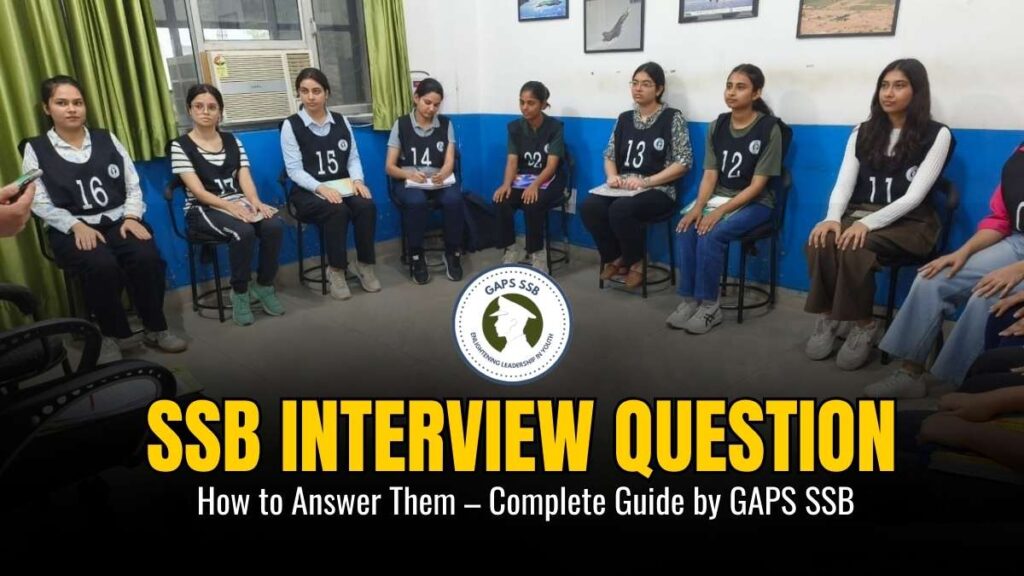
The Services Selection Board (SSB) interview is one of the most important stages in the selection process for candidates who want to join the Indian Armed Forces through entries like NDA, CDS, AFCAT, and other defence exams. The interview is designed to evaluate a candidate’s personality, leadership ability, decision-making skills, and Officer Like Qualities (OLQs). Many aspirants feel nervous because they are unsure about the SSB Interview Question patterns asked by the Interviewing Officer (IO). Understanding the Most Common SSB Interview Question patterns can help candidates prepare confidently and respond naturally during the interview. At GAPS SSB in Delhi, candidates receive structured guidance and mock interview practice to handle every SSB Interview Question effectively. Below is a detailed guide to the Most Common SSB Interview Question categories along with practical answering tips. 1. Tell Me About Yourself One of the Most Common SSB Interview Question candidates face is “Tell me about yourself.” This question helps the Interviewing Officer understand your background and communication ability. Answering Tip Keep your introduction structured and natural. Your answer should include: What to Avoid Avoid giving a long memorized speech. The goal is to show clarity and confidence while answering this SSB Interview Question. 2. Tell Me About Your Family Background Another Most Common SSB Interview Question focuses on your family because the board wants to understand your upbringing and values. Answering Tip Speak respectfully about your family and highlight what you learned from them. Example approach: “My father works as a [profession], and from him I learned discipline and dedication. My mother is a [profession/homemaker], and she taught me patience and responsibility.” This type of response shows maturity and sincerity while answering the SSB Interview Question. 3. Why Do You Want to Join the Armed Forces? This is one of the Most Common SSB Interview Question asked to understand your motivation for joining the military. Answering Tip Connect your answer with values such as: What to Avoid Avoid saying you want to join only for job security or prestige. The board expects genuine motivation when answering this SSB Interview Question. 4. What Are Your Strengths and Weaknesses? Questions about strengths and weaknesses are a Most Common SSB Interview Question designed to evaluate your self-awareness. Answering Tip Mention strengths that relate to Officer Like Qualities, such as: For weaknesses, choose something realistic and explain how you are improving it. Example: “I used to feel nervous while speaking in groups, but I have been improving by practicing group discussions and presentations.” Honesty is important when responding to this SSB Interview Question. 5. Questions Based on Your PIQ Form The Personal Information Questionnaire (PIQ) plays a crucial role in the SSB Interview Question process. Many questions asked by the Interviewing Officer come directly from this form. Answering Tip Be completely honest while filling the PIQ. For example: If you mention reading books as a hobby, you should be ready to answer questions about: Preparation for PIQ-based questions helps candidates confidently handle the Most Common SSB Interview Question types. 6. Current Affairs and General Awareness Questions Questions related to national and international events are another Most Common SSB Interview Question category. Preparation Tip Stay updated with: Example questions may include: Being informed helps candidates respond confidently to this SSB Interview Question category. 7. Situational Questions Situational problems are a Most Common SSB Interview Question used to test decision-making and leadership qualities. Example: “If you see two friends fighting in your group, what will you do?” Answering Tip Your response should show: The goal is to demonstrate maturity while answering this SSB Interview Question. 8. Questions Related to Academics and Career Choices The Interviewing Officer may ask questions related to your academic subjects. Example: “As a mechanical engineering student, how can your knowledge benefit the armed forces?” Answering Tip Explain how your academic knowledge can contribute to problem-solving, technology, or operational efficiency. This shows clarity while answering the SSB Interview Question. 9. Questions About Hobbies and Extracurricular Activities This is another Most Common SSB Interview Question category. If you mention hobbies such as sports, music, or reading, be prepared for follow-up questions. Example: Never write false hobbies in your PIQ, because the Interviewing Officer will explore them during the SSB Interview Question session. 10. Tricky and Stress Questions Sometimes the Interviewing Officer may ask difficult or unexpected questions to test your composure. Example: “If you are not selected this time, what will you do?” Answering Tip Show determination and optimism. Example response: “I will analyze my weaknesses, improve myself, and prepare better for the next attempt.” Handling such moments confidently is key when answering the Most Common SSB Interview Question types. How to Prepare for SSB Interview Questions Preparing for the Most Common SSB Interview Question requires consistent self-improvement and practice. Daily Self-Reflection Review your daily activities and identify situations where you demonstrated leadership or responsibility. Mock Interviews Practicing mock interviews helps you become comfortable with any SSB Interview Question. Improve Communication Skills Clear and confident communication is essential during the interview. Stay Updated with Current Affairs Regular reading helps you answer knowledge-based questions effectively. Be Honest and Natural Authenticity is the most important factor while answering any SSB Interview Question. Role of GAPS SSB in Interview Preparation At GAPS SSB in Delhi, aspirants receive professional guidance to prepare for every Most Common SSB Interview Question through structured training programs. Training includes: The institute focuses on building confidence, clarity, and Officer Like Qualities, which are essential for success in the SSB selection process. Conclusion The SSB interview is not about memorizing answers but about presenting your real personality and leadership potential. Preparing for the Most Common SSB Interview Question helps candidates stay confident and composed during the interview. With regular practice, self-awareness, and proper mentorship, candidates can confidently face any SSB Interview Question and move closer to their goal of joining the Indian Armed Forces.