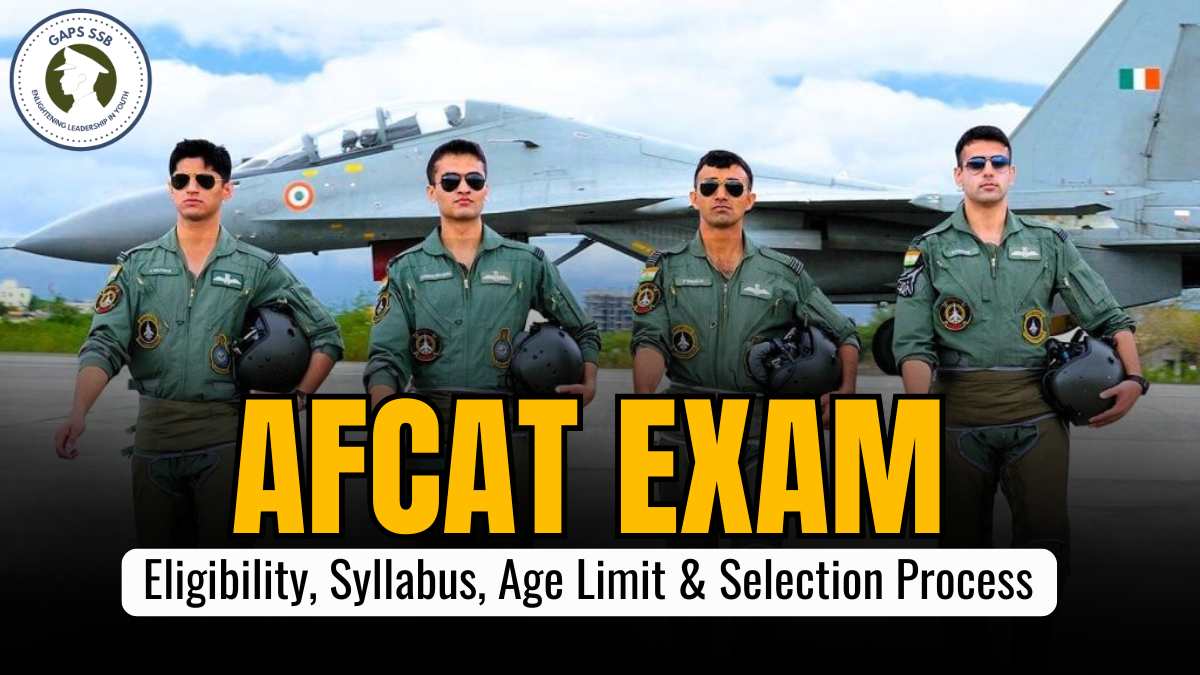
The AFCAT Exam is one of the most important opportunities for aspirants who dream of becoming commissioned officers in the Indian Air Force. Conducted at the national level, this exam opens doors to prestigious branches such as Flying Branch, Ground Duty (Technical), and Ground Duty (Non-Technical).
Every year, thousands of candidates apply for the AFCAT Exam to build a career filled with discipline, pride, and service to the nation. To succeed, it is essential to understand the AFCAT Exam – Eligibility, exam structure, and preparation strategy.
At GAPS SSB, aspirants are guided not only for the written exam but also for personality development and interview preparation to ensure overall success.
What Is the AFCAT Exam?
The Air Force Common Admission Test (AFCAT) is conducted by the Indian Air Force to recruit officers in multiple branches.
Through this exam, candidates can join:
- Flying Branch
- Ground Duty (Technical)
- Ground Duty (Non-Technical)
After clearing the written test, candidates move to the next stage, which is the AFSB interview.
AFCAT Exam – Eligibility
Understanding the AFCAT Exam – Eligibility criteria is the first step before applying.
Educational Qualification
Flying Branch
- Graduation in any discipline with required marks
- Physics and Mathematics at 10+2 level
Ground Duty (Technical)
- Engineering degree in a relevant discipline
Ground Duty (Non-Technical)
- Graduation or post-graduation depending on the role
Candidates must always verify official notifications for exact eligibility conditions.
AFCAT Exam Age Limit
The AFCAT Exam Age Limit varies depending on the branch:
- Flying Branch: 20 to 24 years
- Ground Duty Branches: 20 to 26 years
Age relaxations may apply as per official rules. It is important to check the latest notification before applying.
AFCAT Exam Selection Process
The AFCAT Exam Selection Process is designed to assess both academic knowledge and officer-like qualities.
The selection stages include:
- AFCAT Written Examination
- AFSB Interview (Air Force Selection Board)
- Medical Examination
- Final Merit List
Candidates must perform well in each stage to secure final selection.
AFCAT Exam Pattern
The AFCAT written exam is conducted online and includes multiple-choice questions.
Subjects covered:
- General Awareness
- English Language
- Numerical Ability
- Reasoning and Military Aptitude
Understanding the pattern helps candidates manage time effectively during the exam.
AFCAT Exam Syllabus
A clear understanding of the AFCAT Exam Syllabus is essential for preparation.
English Section
- Vocabulary
- Synonyms and antonyms
- Reading comprehension
- Sentence correction
General Awareness
- Current affairs
- History and geography
- Defence-related news
- Science and technology
Numerical Ability
- Percentage
- Ratio and proportion
- Average
- Profit and loss
- Time and work
Reasoning and Military Aptitude
- Verbal reasoning
- Non-verbal reasoning
- Pattern recognition
- Analytical ability
Regular practice and revision are key to mastering the syllabus.
AFSB Interview Process
Candidates who clear the written exam are called for the AFSB interview.
The process includes:
- Screening tests
- Psychological tests
- Group discussion and group tasks
- Personal interview
- Final conference
This stage evaluates personality, leadership, and communication skills.
Officer-Like Qualities (OLQs)
During the selection process, candidates are assessed on:
- Leadership ability
- Confidence and communication
- Decision-making skills
- Social adaptability
- Sense of responsibility
At GAPS SSB, special focus is given to developing these qualities through structured training and mock sessions.
Preparation Strategy for AFCAT Exam
To crack the AFCAT Exam, candidates should follow a smart preparation approach:
- Understand the complete syllabus and exam pattern
- Practice previous year question papers
- Improve vocabulary and reading habits
- Stay updated with current affairs
- Focus on both written exam and interview preparation
Common Mistakes to Avoid
Many candidates fail due to avoidable mistakes such as:
- Ignoring the syllabus
- Lack of practice in reasoning and numerical sections
- Poor time management
- Not preparing for the AFSB interview
Avoiding these mistakes can significantly improve performance.
How GAPS SSB Helps Aspirants
At GAPS SSB, aspirants receive complete guidance for defence exams:
- Structured preparation for written exams
- Personality development sessions
- Mock interviews and AFSB training
- Regular practice and performance analysis
The focus is on building confidence, discipline, and leadership skills required for success.
Conclusion
The AFCAT Exam offers a great opportunity to join the Indian Air Force as an officer. By understanding the AFCAT Exam – Eligibility, AFCAT Exam Syllabus, AFCAT Exam Age Limit, and AFCAT Exam Selection Process, candidates can prepare in a structured and effective manner.
With dedication, consistency, and the right guidance from GAPS SSB, aspirants can achieve their goal of serving the nation with pride.